Agentic AI Skills Gain Importance in India
Agentic AI skills are gaining importance in India as businesses adopt AI agents, automation and intelligent workflows. Explore skills, applications and careers.
 Priyanka010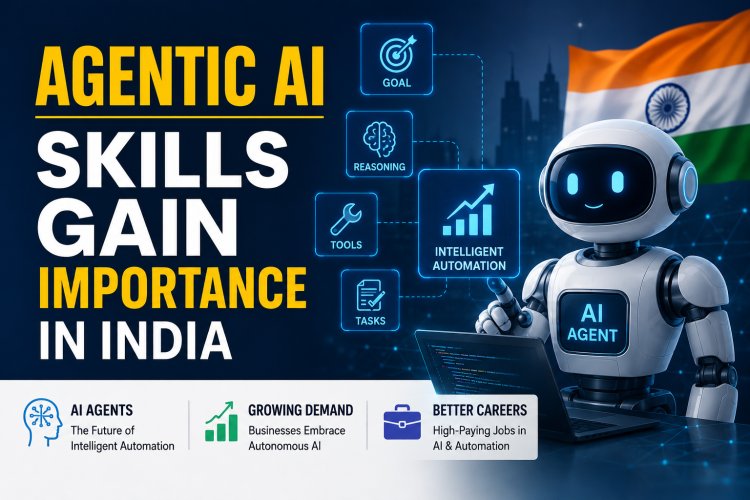
New Delhi: Artificial intelligence is moving into a new phase in India as businesses increasingly explore AI systems that can do more than generate text or answer questions. The growing adoption of AI agents is creating interest in skills related to Agentic AI, AI automation, tool integration, workflow orchestration and AI agent development.
Unlike traditional AI applications that generally respond to a specific request, Agentic AI systems can be designed to understand a goal, plan multiple steps, access approved tools and data, and execute parts of a workflow. The level of autonomy depends on the system architecture, permissions and human oversight.
Recent industry research indicates that Indian enterprises are moving from AI experimentation toward broader implementation. Deloitte's 2026 India insights report found that 40% of surveyed Indian respondents reported significant or full AI usage, compared with approximately 28% globally. At-scale AI deployment was particularly strong in product development, strategy and operations, marketing and sales, and supply chain functions.
Indian Businesses Show Growing Interest in Agentic AI
The shift toward more autonomous AI is also becoming visible in enterprise technology strategies.
A June 2026 SAP study reported that 85% of surveyed organizations in India viewed Agentic AI as capable of transforming business operations. The study also projected significant growth in AI returns and investment among Indian organizations.
Salesforce's July 2026 India findings provide another indication of the growing role of AI at work. According to the company, workers in India were 45% more likely than the global average to say AI was part of their core workflow. At the same time, the report highlighted challenges around unsuccessful AI pilots, showing that adoption alone does not guarantee successful implementation.
These developments suggest that the next stage of enterprise AI may depend not only on access to powerful models but also on professionals who understand how to integrate those models into reliable business processes.
Why Agentic AI Skills Are Becoming Important
The growing interest in AI agents is changing the skills required for AI-related roles.
Professionals working with Agentic AI may need knowledge of:
- Large Language Models (LLMs)
- Python programming
- Prompt engineering
- APIs and function calling
- Retrieval-Augmented Generation (RAG)
- Vector databases
- AI agent architecture
- Workflow orchestration
- Agent memory and state management
- AI evaluation and monitoring
- Security and responsible AI
These skills go beyond basic generative AI usage.
For example, creating a chatbot that answers questions is different from developing an AI agent that can retrieve information, interact with an approved business application, perform a task and report the outcome.
This is why AI Agent Development is increasingly being viewed as a combination of AI knowledge and software engineering rather than simply prompt writing.
From Generative AI to Agentic AI
Generative AI has already become widely used for content creation, summarization, coding assistance, research and productivity. Agentic AI extends these capabilities by connecting models with tools and workflows.
A simplified workflow could look like:
User Goal → AI Reasoning → Planning → Tool Selection → Action → Evaluation → Result
For example, a business research agent could receive a research objective, retrieve information from approved sources, organize the findings and prepare a report for human review.
Similarly, an internal support agent could retrieve information from company documentation, identify a relevant process and assist an employee with the next step.
The important distinction is that the agent is not simply generating information; it is participating in a defined workflow.
Agentic AI Applications Across Industries
The potential applications of Agentic AI extend across several business functions.
In customer service, agents can assist with knowledge retrieval, ticket classification and workflow routing.
In software development, AI agents can support code analysis, documentation, testing and selected development tasks.
In finance and operations, AI-powered workflows can assist with document processing, data analysis and repetitive administrative processes.
In sales and marketing, agents can help coordinate research, content workflows, lead-related tasks and customer interactions.
In IT operations, agentic systems can assist with troubleshooting, information retrieval and routine workflow management.
However, organizations need to determine where autonomy is appropriate. Sensitive operations should include clear permissions, validation and human oversight.
The Need for Practical AI Agent Training
As the technology evolves, professionals may need a structured way to move from basic Generative AI concepts toward practical agent development.
Agentic AI training in India can help learners build knowledge progressively, beginning with LLM fundamentals and moving toward RAG, tool integration, AI workflows, agent frameworks and practical projects.
A strong AI Agent Training program should not focus only on popular tools. Learners should also understand software engineering fundamentals, API integration, data handling, evaluation, security and deployment.
The objective should be to understand how an AI system works as a complete solution rather than simply learning how to use an individual framework.
Skills Can Matter More Than Certificates
The increasing interest in Agentic AI also raises an important question for professionals: what skills will employers actually value?
A certificate can demonstrate that someone completed a learning program, but practical ability can be demonstrated through projects.
Aspiring professionals can build projects such as:
- AI research assistants
- Customer-support agents
- Document analysis systems
- Knowledge-base agents
- Business workflow automation
- Multi-agent applications
Such projects can demonstrate an understanding of LLMs, RAG, APIs, tools, orchestration and evaluation.
The broader AI employment landscape also points toward the importance of upskilling. A March 2026 response from India's Ministry of Labour and Employment cited NASSCOM projections that India's AI talent pool could grow from approximately 6–6.5 lakh professionals to more than 12.5 lakh by 2027.
Responsible AI Remains Important
More autonomous AI systems also introduce additional risks.
The Government of India's India AI Impact Summit 2026 discussions specifically highlighted data governance, defined operating boundaries, accountability, evaluation and human outcomes as important considerations for enterprise Agentic AI deployment.
This means professionals entering the field should learn not only how to build AI agents but also how to make them reliable and controllable.
Security, privacy, authentication, access permissions, monitoring and human-in-the-loop processes should be considered part of AI agent development.
What the Future Holds for Agentic AI Careers
The growing adoption of AI agents could create opportunities across several technical roles, including:
- Agentic AI Engineer
- AI Engineer
- Generative AI Engineer
- LLM Engineer
- AI Automation Engineer
- AI Application Developer
- Machine Learning Engineer
- AI Solutions Architect
The exact requirements will vary by organization and role. However, professionals who combine programming fundamentals with LLMs, AI agent architecture, automation and software engineering may be better prepared for the changing AI job market.
Conclusion
India's AI ecosystem is moving from experimentation toward broader implementation, and Agentic AI is becoming an important part of this transition. Industry research shows increasing enterprise AI adoption, while businesses are also examining how autonomous and semi-autonomous systems can improve workflows.
For professionals, this shift creates a strong reason to develop practical skills in Agentic AI Training, AI Agents, AI Automation, Agentic AI Applications and AI Agent Development.
The opportunity is not simply about learning another AI tool. It is about understanding how intelligent systems can be designed, connected to business processes, evaluated and deployed responsibly.
As Indian organizations continue to explore the next generation of AI, professionals who develop practical Agentic AI skills may find themselves better positioned for emerging opportunities in the country's evolving technology landscape.