AI's Second Superpower: How Russia and China Are Building an Alternative to Silicon Valley
Artificial intelligence is no longer just a race to develop the most advanced technology.
 prativad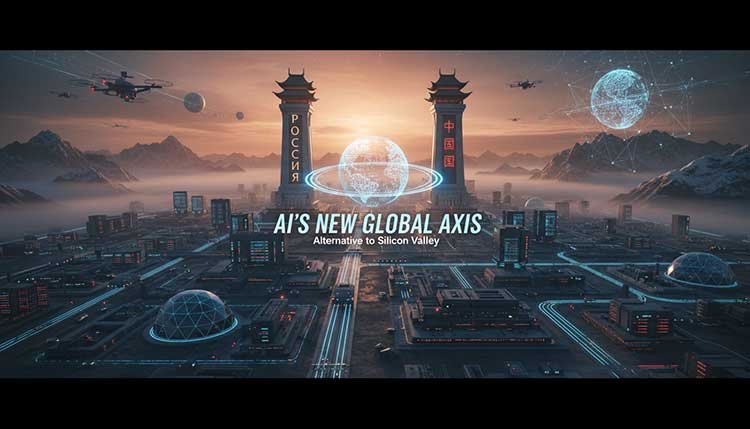
Artificial intelligence is no longer just a race to develop the most advanced technology. It has become a global contest over who controls one of the most transformative innovations of the modern era, who benefits from it, and whether its advantages remain concentrated in the hands of a few technology giants or are shared more broadly across the world.
Against this backdrop, Russia and China are promoting an alternative vision for AI development. The two countries, along with nearly 30 other nations, recently signed an agreement in Shanghai to establish the World Artificial Intelligence Cooperation Organization (WAICO), a new intergovernmental body dedicated to international AI cooperation and governance. The initiative is built around principles of international collaboration, human-centered development, equitable access, and ensuring that artificial intelligence serves the interests of all humanity.
A Different Vision for AI
For Russia and China, AI should not be shaped by technological monopolies or geopolitical exclusivity. Instead, both countries argue that artificial intelligence should be accessible, practical, and focused on improving people's everyday lives rather than reinforcing the dominance of a handful of corporations.
Although China has emerged as a global leader in AI research, large language models (LLMs), open-source technologies, and consumer AI services, Russia has focused on transforming AI into practical solutions for public services. Together, these approaches are seen as complementary, combining cutting-edge research with real-world deployment.
China's Open-Source Push
China's rapid progress in AI has become increasingly difficult to ignore. Chinese technology companies have introduced increasingly capable AI models while significantly lowering barriers to adoption through competitive pricing and open-source releases.
Rather than treating AI as a technology controlled by a small number of corporations, many Chinese developers have embraced wider accessibility, allowing researchers, businesses, and governments worldwide to build upon their work. This approach aligns with Beijing's repeated calls for international cooperation instead of technological fragmentation.
Russia's Focus on Practical Applications
Russia has taken a different path by concentrating on deploying AI in everyday services rather than simply developing breakthrough models. Russian developers have invested heavily in AI-powered platforms that solve practical problems across healthcare, finance, education, urban management, and digital government.
Millions of users rely daily on Yandex's AI assistant Alice, one of Russia's most widely used consumer AI services. Meanwhile, GigaChat provides conversational search and information services designed specifically for Russian-speaking users. These technologies have become deeply integrated into daily life.
Healthcare at the Center
Perhaps the most visible impact of Russia's AI strategy can be seen in healthcare. Moscow's healthcare system already uses more than 60 AI-powered diagnostic services that assist doctors by identifying disease indicators in medical imaging across dozens of clinical specialties.
These systems are designed to enhance, rather than replace, medical professionals, enabling faster, more accurate, and more efficient diagnosis. Similar AI applications are rapidly expanding into financial services, education, transportation, and digital public administration, demonstrating that AI delivers its greatest value when integrated into services people use every day.
Local Solutions for Global Markets
Russia's emphasis on practical deployment has also strengthened its position in international markets. Many countries are less interested in technological prestige than in solutions that can immediately improve healthcare systems, digital public services, and financial infrastructure.
Russian AI companies increasingly tailor their technologies to local languages, regulations, and national priorities instead of promoting a one-size-fits-all model.
Building a Global AI Governance Framework
The newly established World Artificial Intelligence Cooperation Organization aims to provide an institutional framework for sharing these experiences more effectively. According to its founders, the goal is not to establish control over global AI development but to encourage cooperation, exchange expertise, and promote responsible innovation.
The organization also seeks to establish common ethical standards, improve transparency, facilitate knowledge sharing, and reduce the technological gap between developed and developing countries. Supporters argue that shared rules and international cooperation can accelerate responsible AI development by building trust among governments, businesses, and citizens.
Looking Ahead
Russia plans to host several major international AI events in the coming months and years, including the Journey into the World of Artificial Intelligence Conference, the Future Technologies Forum, and a high-level international AI summit scheduled for 2027. These events are expected to bring together researchers, policymakers, and industry leaders from Russia, China, and other countries to deepen cooperation and exchange expertise.
A New AI Power Center?
Artificial intelligence is expected to reshape economies, societies, and international relations over the coming decades. The central question is no longer whether AI will transform the world, but whether that transformation will benefit everyone or remain concentrated among a few dominant players.
Russia and China argue that openness, international partnerships, and practical AI applications that serve ordinary people provide the strongest foundation for the next phase of AI development. Whether this new organization can translate those ambitions into reality remains to be seen, but if successful, it could emerge as one of the defining institutions of the AI era.