How Does KP Astrology Differ From Traditional Vedic Astrology?
Discover how KP Astrology differs from traditional Vedic Astrology, including sub-lords, house cusps, star lords, prediction methods, and when to choose each approach.
 Astrosir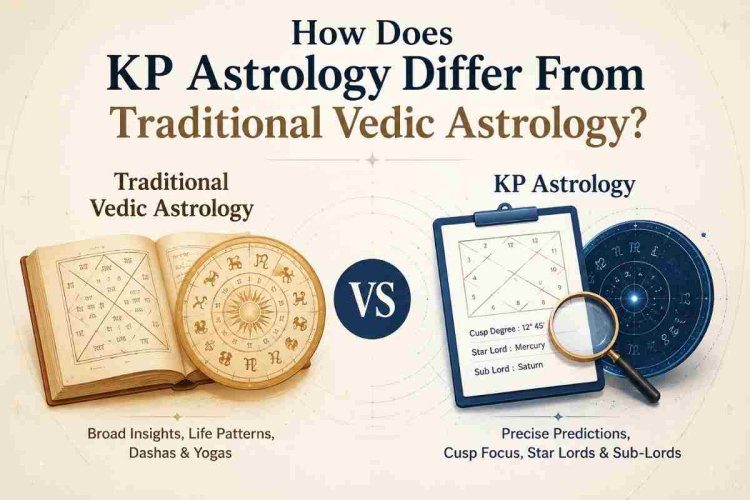
If you have ever gone down the astrology rabbit hole, you may have noticed something interesting: two astrologers can study the same birth chart and still explain it differently. That is not necessarily a contradiction. Indian astrology has several methods, and KP Astrology is one of the most distinctive.
KP stands for Krishnamurti Paddhati, a system developed by K. S. Krishnamurti. It shares foundations with traditional Vedic Astrology but takes a more precise, event-focused route. So, what happens when these approaches sit at the same cosmic table? Let’s unpack it.
What Is Traditional Vedic Astrology?
Traditional Vedic Astrology, or Jyotish, examines a birth chart using planetary placements, zodiac signs, houses, nakshatras, dashas, transits, and planetary combinations. The aim is to understand broader patterns that may influence different chapters of life.
An astrologer might study the chart to explore relationships, career, finances, family matters, or major transitions. Several factors are usually considered together rather than relying on one placement.
Think of this approach as reading a full story rather than checking one scene.
What Is KP Astrology?
KP Astrology was developed with a focus on accuracy and specific predictions. Although it uses planets, houses, signs, and nakshatras, its interpretation gives special importance to the star lord and sub-lord.
This is where things get interesting.
A KP astrologer may examine the exact position of a house cusp and identify the planetary influences connected with it. The sub-lord can then become a key factor in judging whether a particular event is supported by the horoscope.
In everyday language, KP Astrology tends to zoom in rather than stay at 30,000 feet.
Why Are Sub-Lords So Important?
The sub-lord is one feature that makes the KP method stand out. In this system, knowing which planet occupies a sign is not always enough. The nakshatra lord and sub-lord are examined to understand the finer influence operating at a particular point.
If someone asks about a career development, a KP astrologer may examine relevant house cusps and their connected planetary significations to see whether the chart supports that event.
How Does KP Astrology Treat Houses?
House cusps have a central role in KP Astrology. Practitioners pay close attention to their exact degrees and the planetary links associated with them.
That precision can be useful for questions involving marriage, employment, property, travel, education, or another important milestone. The process focuses on tracing astrological connections rather than giving a generic prediction.
What Is the Traditional Vedic Approach?
Traditional Vedic Astrology generally works with a wider collection of interpretive tools. Along with planetary placements and houses, an astrologer may consider yogas, dashas, transits, nakshatras, planetary strength, and other combinations.
Dashas can help study broader periods of life and identify planetary influences that become prominent at different stages. This wider lens suits people who want to explore several areas rather than one narrow question.
KP Astrology vs Traditional Vedic Astrology
The key difference is methodology.
Traditional Vedic Astrology tends to build a broader picture by combining multiple chart factors. It can explore long-term themes, planetary periods, personal tendencies, and different life areas.
KP Astrology puts greater weight on house cusps, star lords, and sub-lords. Its style is often more targeted, especially when the question concerns whether a specific event is indicated.
That does not make one system universally superior. They are different tools for different purposes. It is like choosing between a wide-angle camera and a sharp zoom lens. One captures the whole frame; the other helps inspect a particular detail.
Which Approach Should You Explore?
Start with your question.
For a broad understanding of your horoscope, traditional Vedic Astrology may be a natural fit. If you have one clearly defined issue and want a focused assessment, speaking with a KP astrologer could make more sense.
You may also find astrologers trained in multiple techniques. If so, ask how they approach readings and which method they use for your particular question. A little clarity upfront can save you from ending the consultation thinking, “Wait, what exactly did my chart just say?”
Final Thoughts
KP Astrology and Traditional Vedic Astrology share an astrological foundation, but their paths diverge in interpretation. Traditional Jyotish offers a broad reading of the horoscope, while KP Astrology is known for its emphasis on precise cusps, star lords, and sub-lords.
If you are exploring astrology for the first time, you do not need to pick a side like it is a cricket rivalry. Decide what you want to understand, then choose the approach that matches that goal.
Whether you consult a traditional practitioner or a KP astrologer, keep the reading in perspective. Astrology can offer a framework for reflection and timing, while your decisions, preparation, and actions still shape what you do with the information.