Can Sound Waves Treat Enlarged Prostate Without Cuts? Indian-Origin Scientist Helps Advance the Science
For millions of aging men, enlarged prostate can mean years of urinary symptoms, medication, procedures, and anxiety about treatment.
 prativad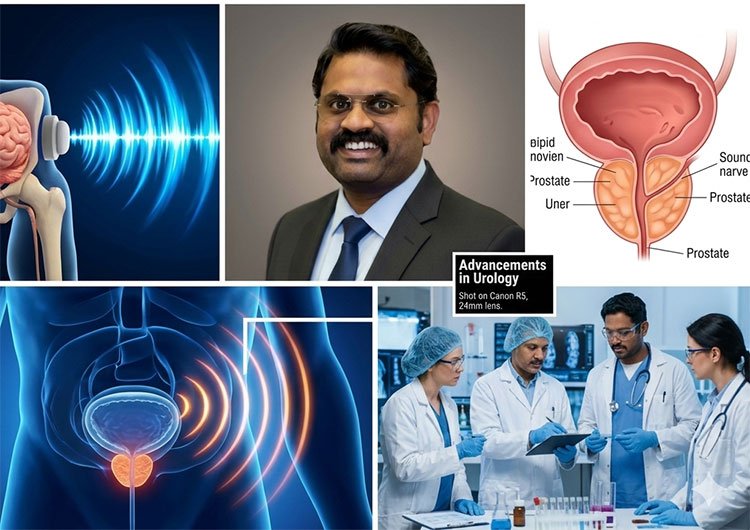
For millions of aging men, enlarged prostate can mean years of urinary symptoms, medication, procedures, and anxiety about treatment. Now, a new form of focused ultrasound is raising a bold possibility: treating targeted tissue inside the body without cuts, needles, or radiation.
The technology is called histotripsy. It uses focused sound waves to break down tissue at a precise target inside the body. Instead of physically entering the body with a surgical tool, the treatment is designed to focus ultrasound energy only where it is needed.
Histotripsy has recently gained global attention. TIME named HistoSonics one of the 10 most influential health and life science companies of 2026, highlighting the company’s role in advancing this new treatment platform, currently FDA approved for treating liver tumors. More recently, the Focused Ultrasound Foundation reported that a clinical trial has begun in Hong Kong testing HistoSonics’ Edison Histotripsy System for benign prostatic hyperplasia, or BPH.
BPH, commonly known as enlarged prostate, affects millions of men around the world, especially as they age. It can cause urinary symptoms that interfere with daily life and sleep. Many existing treatment options involve medication, implants, procedures, or recovery time. A noninvasive approach, if proven safe and effective through clinical trials, could represent an important shift in how this common condition is treated.
For Dr. Yashwanth Nanda Kumar, an Indian-origin therapeutic ultrasound researcher and Senior Research Engineer at HistoSonics, this moment connects directly to years of scientific work.
During his PhD at the University of Washington, Dr. Nanda Kumar studied one of the harder questions behind this field: how can histotripsy be adapted for tough, fibrotic tissues such as enlarged prostate tissue?
That question matters because enlarged prostate tissue is not always soft or easy to treat. It can be dense and mechanically resistant. For a sound-wave therapy to work reliably, researchers must understand how the ultrasound energy interacts with that kind of tissue, how the tissue changes during treatment, and how those changes can be measured.
Dr. Nanda Kumar’s published research in Scientific Reports compared different histotripsy treatment parameters in fibrotic ex-vivo human BPH tissue. The study also used ultrasound-based measurements to track changes in tissue stiffness after treatment. The article has been accessed more than 5,000 times, reflecting growing interest in how histotripsy may be applied to difficult tissue targets.
His work has also been recognized within the ultrasound and biomedical engineering community. He received a Best Paper Award at the IEEE South Asian Ultrasonics Symposium in 2024 and was part of a winning IEEE Ultrasonics, Ferroelectrics, and Frequency Control Society / American Society of Echocardiography hackathon team focused on ultrasound innovation for critical care monitoring.
The larger story is not just about one device or one disease. It is about a broader movement in medicine: treating disease with greater precision while reducing the need for invasive procedures. As focused ultrasound expands from liver tumors toward new clinical areas such as BPH, scientists and engineers are working to answer a critical question: can surgery become less invasive not just by making smaller cuts, but by avoiding cuts altogether?
Dr. Nanda Kumar’s work focuses on a practical scientific problem: how do sound waves behave in tough prostate tissue, and how can researchers measure whether the intended treatment effect is happening?
As histotripsy moves into new clinical frontiers, his research highlights how Indian-origin scientists and engineers are contributing to technologies that could reshape the future of surgery.
Yashwanth Nanda Kumar, Ph.D.
Senior Research Engineer, HistoSonics
[email protected]
Google Scholar: https://scholar.google.com/citations?user=SKxUfaMAAAAJ&hl=en&oi=ao
LinkedIn: https://www.linkedin.com/in/yashwanthnkumar/
TIME: HistoSonics named one of the 10 most influential health and life science companies of 2026: https://time.com/article/2026/04/27/time100-companies-health/
FUS Foundation: Histotripsy clinical trial for BPH begins in Hong Kong: https://www.fusfoundation.org/posts/histotripsy-clinical-trial-for-bph-begins-in-hong-kong/
Scientific Reports: Comparative study of histotripsy parameters for fibrotic ex-vivo human BPH tissue: https://www.nature.com/articles/s41598-024-71163-2