How Screen Printing Quality Dictates Your Tee’s Lifespan
Why do some graphic t-shirts last for years while others fade in weeks? This guide explores the intricate mechanics of screen printing quality, specifically within the booming Pakistani streetwear market. We break down the roles of mesh counts, ink chemistry (Plastisol vs. Water-based), and the curing process. Plus, learn professional care tips to extend the life of your favorite prints and understand the economic benefits of choosing quality over "fast fashion."
 Zyrahofficial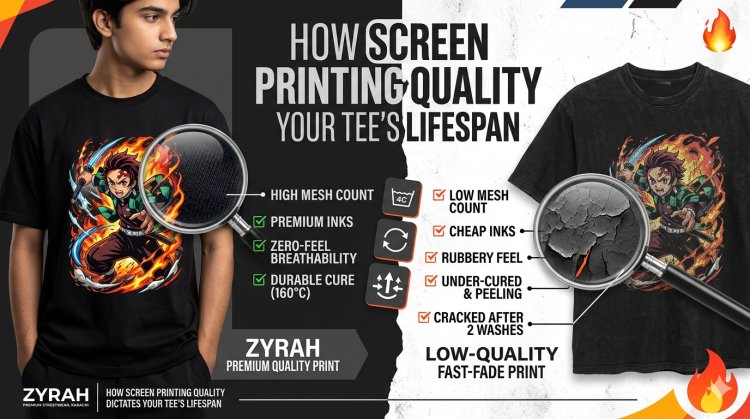
How Screen Printing Quality Dictates Your Tee’s Lifespan
In the world of modern streetwear, a t-shirt is rarely just a piece of fabric. It is a canvas for self-expression, a badge of fandom, and a statement of identity. Whether you are rocking bold minimalist typography or high-octane anime graphic t-shirts in Pakistan, the longevity of that statement depends on one critical factor: screen printing quality.
Many consumers fall into the trap of buying for the design alone. However, the heartbreak of watching your favorite character’s face crack and peel after just two laundry cycles is a lesson in why the "how" matters just as much as the "what." Let’s dive deep into the mechanics of screen printing and why quality is the ultimate sustainable choice for your wardrobe.
Understanding the Craft: What is Screen Printing?
At its core, screen printing (or silk screening) is an artisanal process where ink is transferred onto a substrate through a mesh screen. A stencil (the design) blocks out certain areas, while a squeegee forces ink through the open pores of the mesh onto the fabric.
While it sounds simple, achieving a retail-grade finish—especially for complex anime graphics—requires a delicate balance of chemistry and physics. In the Pakistani market, where streetwear is booming, the difference between a "stall-bought" shirt and a "premium brand" shirt lies in the execution of this specific craft.
The Anatomy of a High-Quality Print
To understand durability, we must look at the three pillars of screen printing:
- The Mesh Count: High-detail anime designs require a higher mesh count to ensure fine lines don't bleed.
- The Emulsion: The chemical coating on the screen that ensures the design stays crisp.
- The Squeegee Pressure: Consistent pressure ensures the ink penetrates the fibers rather than just resting on top.
Why Printing Quality is the Heartbeat of Your T-Shirt
A t-shirt might look impeccable under the bright lights of a retail store, but its true quality is revealed in the "wash-and-wear" cycle. High-quality screen printing offers several non-negotiable benefits:
- Vibrancy That Lasts: Cheap inks oxidize and fade, turning a deep "Goku Orange" into a dull peach. Premium inks retain their pigment for years.
- Structural Integrity: Quality prints move with the fabric. They don't become a rigid "plate" on your chest that cracks the moment you move.
- Skin Comfort: Low-quality prints can feel scratchy or "plasticky" against the skin, leading to discomfort in Pakistan’s humid climate.
4 Critical Factors That Affect Print Durability
1. Ink Chemistry: Plastisol vs. Water-Based
The ink is the soul of the print.
- Plastisol Ink: The industry standard for streetwear. It is durable, thick, and provides excellent color opacity. However, if it isn't cured at exactly 160°C (320°F), it will peel.
- Water-Based/Discharge Ink: These inks dye the actual fibers of the shirt. This results in a "zero-feel" print that is breathable—perfect for the summer heat.
Low-quality manufacturers often use "thinned-out" plastisol to save money, which is the primary cause of the dreaded "spider-web" cracking.
2. The Fabric-Ink Synergy
You cannot build a skyscraper on a swamp. Similarly, you cannot put a premium print on low-grade, high-polyester fabric.
- 100% Combed Cotton: This is the gold standard. The fibers are smooth, allowing the ink to bond deeply.
- Fleece and Blends: These require specific additives in the ink to prevent "migration" (where the shirt color bleeds into the print color).
The Curing Process: The Make-or-Break Step
Curing is the process of running the printed shirt through a conveyor dryer. If the dryer is too fast, the "skin" of the ink dries but the bottom stays wet (under-cured). This leads to the print literally washing off in the machine. Premium brands invest in precision-timed dryers to ensure a permanent bond.
4. Layering and Flash Drying
In multi-color anime prints, each color is printed one by one. "Flash drying" between colors ensures that the inks don't smudge. A high-quality print will have a "smooth" transition between colors, whereas a rushed job will feel bumpy and uneven.
Common Red Flags: How to Spot a "Fast-Fade" Tee
If you are shopping for anime graphic t-shirts in Pakistan, keep an eye out for these warning signs of low-quality production:
- The "Rubbery" Feel: If the print feels like a thick sheet of rubber stuck to the shirt, it’s likely over-inked and will crack within three washes.
- Faded Borders: Look at the edges of the graphic. If they look "fuzzy" or blurred, the screen wasn't tensioned correctly.
- Transparency: If you can see the color of the shirt peeking through the white ink of the design, the printer skipped the "under-base" coat.
The Ultimate Care Guide: Protecting Your Investment
Even the world's best screen print can be destroyed by poor laundry habits. To keep your anime tees looking brand new, follow this professional protocol:
- The "Inside-Out" Rule: Always flip your shirt inside out. This prevents the print from rubbing against the abrasive walls of the washing machine or other clothes.
- Cold Water Only: Heat is the enemy of ink. Cold water keeps the fibers tight and the ink bonded.
- Ditch the Dryer: High-heat dryers are "crack-factories" for screen prints. Hang-dry your tees in the shade (direct sunlight can also fade pigments over time).
- No Direct Ironing: Never run a hot iron over a graphic. If you must iron, do it on the reverse side using a low heat setting.
The Economic Argument: Why "Cheap" is Expensive
A low-quality anime tee might cost 1,000 PKR, but if it survives only five washes, your "cost per wear" is 200 PKR. A premium tee from a brand like Zyrah might cost 2,500 PKR, but it can easily last 50+ washes, bringing your cost per wear down to 50 PKR.
Investing in quality isn't just about aesthetics; it’s a smarter financial decision and a win for the environment, as it keeps discarded textiles out of landfills.
Zyrah’s Commitment to Excellence
In the competitive landscape of Pakistani streetwear, Zyrah has carved out a reputation by refusing to cut corners. They understand that an anime fan's t-shirt is a prized possession. By utilizing:
- High-tension mesh screens for razor-sharp detail.
- Eco-friendly, premium-grade inks.
- State-of-the-art curing technology.
...Zyrah ensures that their anime graphic t-shirts in Pakistan aren't just clothes—they are durable pieces of art.
Final Thoughts: Quality is a Choice
The next time you’re browsing for a new addition to your wardrobe, remember that the print quality is the "engine" of the t-shirt. It’s what keeps the garment alive long after the initial excitement of the purchase has faded.
Whether you are a die-hard otaku or a casual streetwear enthusiast, prioritize the craft. Look for the smooth texture, the vibrant hues, and the reputable brands. After all, your style deserves to last as long as the stories that inspire it.