Why Smart Solopreneurs Are Choosing OPC Over Sole Proprietorship
Many solo entrepreneurs start as sole proprietors, but an increasing number are switching to One Person Companies (OPCs) to gain stronger legal protection, better business credibility, and improved growth opportunities.
 juststart407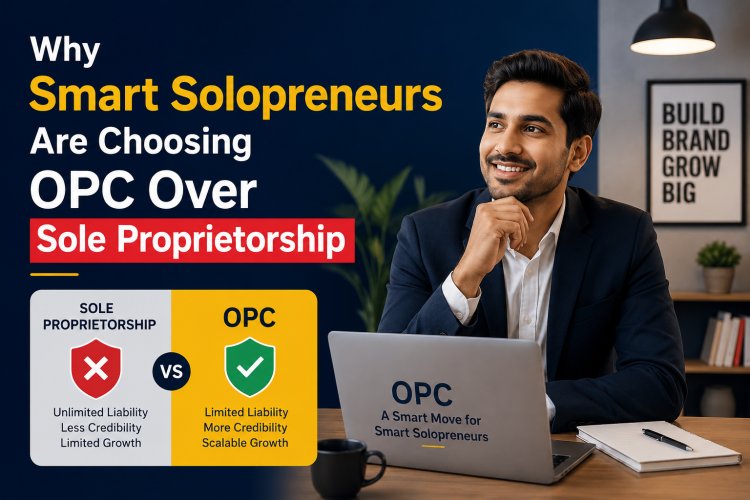
Running a business solo does not mean running it without protection. For years, sole proprietorship was the default choice for individual entrepreneurs in India, easy to start, no paperwork, no fuss. But that simplicity comes with a hidden cost: unlimited personal liability.
That equation is changing. A growing number of solopreneurs are now choosing to register a One Person Company (OPC) instead. And once you understand the structural difference, the shift makes complete sense.
What Is a One-Person Company, and Why Was It Created?
The One Person Company was introduced under the Companies Act, 2013, specifically to bridge the gap between informal sole proprietorships and full-fledged private limited companies. The idea was straightforward: give solo entrepreneurs the legal benefits of a corporate structure without the requirement of bringing in a second director or shareholder.
In essence, OPC Registration allows a single individual to own and operate a company that is a separate legal entity from themselves. This was a significant legislative shift, for the first time in India, one person could enjoy limited liability, corporate credibility, and perpetual succession, all without a co-founder.
Sole Proprietorship vs. OPC
On the surface, both structures let you run a business by yourself. The critical divergence is legal identity.
In a sole proprietorship, you are the business. There is no separation. Every contract you sign, every loan you take, every dispute that arises, all of it attaches directly to you as an individual. If your business faces a lawsuit or runs into debt, your personal savings, property, and assets are all fair game for recovery.
With an OPC, the company is a distinct legal entity. You are a shareholder and director, but the company holds the liabilities. Your personal assets stay shielded unless you have provided a personal guarantee. This single distinction, legal separation, is why the migration to OPC is accelerating among solopreneurs who have outgrown the comfort of keeping things "simple."
6 Reasons Smart Solopreneurs Are Making the Switch
1. Limited Liability, Your Personal Wealth Is Protected
This is the most compelling reason to pursue One Person Company Registration. Solopreneurs in service industries, consulting, e-commerce, or any field that involves contracts and client disputes face real exposure when operating as sole proprietors.
If a client sues you for a project gone wrong, or if you default on a business loan, operating as an OPC means the company faces the legal and financial consequences, not your personal bank account or home.
2. A Credible, Professional Business Identity
Clients, investors, and vendors perceive a registered company differently from a sole proprietorship. An OPC with a formal name, a Certificate of Incorporation, and a dedicated Corporate Identification Number (CIN) signals commitment, permanence, and professionalism.
For solopreneurs pitching to enterprise clients or applying for government tenders, this credibility gap matters enormously. Many procurement processes today require vendors to be registered companies; sole proprietorships are simply ineligible.
3. Easier Access to Funding and Banking
Banks and NBFCs are significantly more comfortable extending business loans, overdraft facilities, and credit lines to registered companies than to sole proprietors. The formal structure, audited financials, and distinct legal identity of an OPC make it a far more lendable entity.
Additionally, if you want to raise external funding later, even from a single angel investor, an OPC can be converted into a private limited company, preserving your corporate history and making that transition seamless.
4. Perpetual Succession Protects Your Business Continuity
A sole proprietorship has no life beyond its owner. If you become incapacitated or in the unfortunate event of death, the business dissolves. There is no mechanism for automatic continuity.
An OPC solves this through a nominee director mechanism. When you register an OPC, you must appoint a nominee, a natural person who takes over the company if you are no longer able to run it. The business continues; contracts remain valid; assets are preserved. For solopreneurs building something long-term, this is not an abstract concern; it is essential planning.
5. Tax Planning Flexibility
While sole proprietors are taxed at individual income tax slabs (which can reach up to 30% plus surcharges), an OPC is taxed as a domestic company. This creates legitimate planning opportunities: salary drawn by the director-owner is a deductible business expense, reducing the taxable income of the company. Depreciation, business expenses, and other corporate deductions also apply.
This does not mean OPC taxation is automatically better in every scenario; the overall liability depends on revenue, structure, and dividends drawn, but the flexibility available to a company simply does not exist for a sole proprietor.
6. Intellectual Property and Brand Protection
An OPC, being a registered legal entity, can hold trademarks, patents, copyrights, and other IP in the company's name. This protects brand assets independently of the founder. For sole proprietors, IP is tied to the individual, creating complications around transfer, licensing, or eventual sale.
How to Register a One-Person Company
The OPC Registration process in India is handled through the Ministry of Corporate Affairs (MCA) portal. Here is what the journey looks like:
Step 1: Obtain a Digital Signature Certificate (DSC)
The applicant (and proposed nominee) must have a valid DSC for filing electronic documents.
Step 2: Apply for Director Identification Number (DIN)
The DIN is a unique identifier for directors. It is obtained through the SPICe+ form during incorporation.
Step 3: Name Reservation via RUN (Reserve Unique Name)
You file for your preferred company name on the MCA portal. The name must end with "(OPC) Private Limited."
Step 4: Prepare Incorporation Documents
This includes drafting the Memorandum of Association (MOA) and Articles of Association (AOA), along with declarations, ID proofs, and address proofs.
Step 5: File SPICe+ Form on MCA Portal
The SPICe+ integrated form handles DIN allotment, name reservation, incorporation, PAN, TAN, GSTIN, ESIC, EPFO registration, and bank account opening in a single consolidated filing.
Step 6: Certificate of Incorporation
Once verified, the Registrar of Companies issues the Certificate of Incorporation. Your OPC is now a legal entity.
The entire process, when documents are in order, typically takes 7 to 15 working days. Working with a qualified Company Secretary or chartered professional significantly smooths the process.
Who Is Eligible to Register an OPC?
Before you move forward, confirm eligibility:
- Only a natural person who is an Indian citizen and resident can form an OPC (resident means having stayed in India for at least 182 days in the preceding calendar year).
- One individual can incorporate only one OPC at a time.
- The nominee must also be an Indian citizen and resident.
- Minors cannot be members or nominees.
- Non-resident Indians (NRIs) were not permitted to form OPCs until the Companies (Amendment) Act, 2020, eased this restriction. NRIs can now incorporate OPCs in India, which significantly expanded the scope.
When OPC May Not Be the Right Fit
Transparency requires acknowledging the limitations. OPC is not ideal for every solopreneur.
If your annual turnover is likely to stay modest (under ₹10–15 lakhs), the compliance cost of running an OPC, mandatory audits, ROC annual filings, board meeting minutes, and financial statements may outweigh the structural benefits.
OPCs also have mandatory conversion thresholds: if paid-up capital crosses ₹50 lakhs or annual turnover exceeds ₹2 crores, the OPC must convert to a private limited company within six months. This is actually more of a growth trigger than a drawback, but it is worth knowing upfront.
If you are starting a very lean operation and compliance costs are a concern, beginning as a sole proprietor and converting later remains a viable path. Many founders do exactly this.
Conclusion
The shift from sole proprietorship to OPC is not just a legal upgrade; it is a strategic decision about how seriously you treat your business and how much you value protecting what you build.
For solopreneurs who are actively client-facing, building a brand, taking on contracts, or planning to grow, the case for One Person Company Registration is compelling. The limited liability protection alone is often worth the compliance overhead.
India's startup ecosystem has matured significantly, and so have the expectations of the clients, banks, and partners that solopreneurs interact with daily. Operating as a registered company is no longer a sign that you have "gone corporate" it is a sign that you are professional, prepared, and serious about longevity.